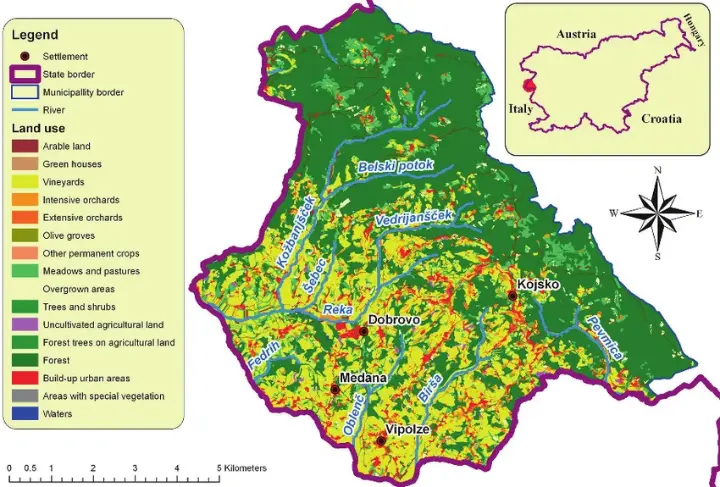
This time, we explore one of the most fascinating and dynamic wine regions of Central Europe: Goriška Brda. Located in the far west of Slovenia, directly bordering the Italian Collio DOC, lies a world-class micro-terroir. Here, a unique microclimate, legendary soil, centuries-old traditions, and an embrace of modern knowledge and techniques ensure the production of wines bursting with character, minerality, and aging potential.
Some figures that will surprise you: 5,700 people live in this wine region. And there are 700 wine producers. That is one producer for every 8 inhabitants. Of those other 7, a further portion works for those wine producers. Together, they cultivate just under 2,000 hectares of vineyards. (That is roughly the same as the Jura, or about 2.5 times the size of Pomerol.) As you can see: everyone here lives for wine. Without wine, there is no Goriska Brda, and there is no Goriska Brda without wine.
The literal translation of the wine region's name is the mountains/hills of Brda. The terrain is indeed particularly undulating, with very steep slopes. As a result, terraced viticulture is the predominant method, and winemakers have ample choice regarding sun exposure. This allows for the cultivation of grapes such as Pinot Noir and Merlot in the same region.
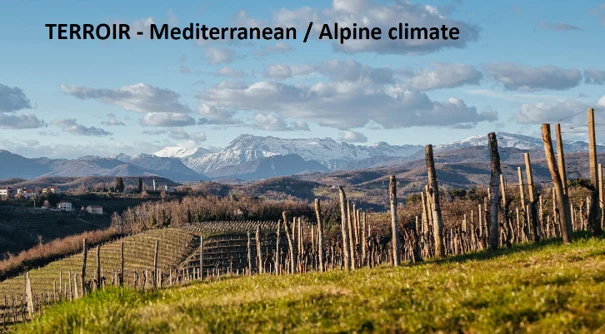
Unique location
Goriska is situated in a truly unique location for viticulture. On the one hand, it is located just a few kilometers from the Mediterranean Sea as the crow flies. On the other hand, the area is situated at the foot of the Julian Alps. Goriska Brda is therefore a natural corridor where the warm sea breezes from the Mediterranean and the cool downdrafts from the Alps meet. This creates a unique microclimate where the grapes receive sufficient sun and warmth during the day, while the vineyards cool down effectively at night. It is precisely these day/night temperature differences that ensure even ripening and, consequently, high-quality grapes.
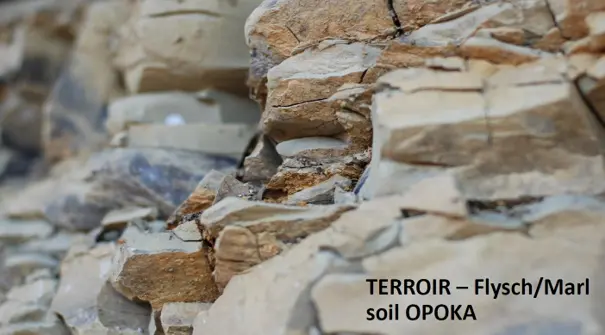
Opoka: ancient soils
The soil here consists of Opoka (also known as flysch). This is a millions-of-years-old layered sedimentary soil of alternating calcareous marl and sandstone. Opoka is a living soil: it crumbles easily into a mineral-rich humus, bursting with potassium and phosphorus. This gives the wines their characteristic salinity, vibrant freshness, and immense depth. Because the steep slopes require manual tillage, viticulture here is pure craftsmanship.
Grape varieties
In the region, approximately 60% of the plantings are dedicated to white grapes. We will write a separate piece below about the most important of these, Rebula. The other typical white grapes for the region are Sauvignonasse (Jakot/Friulano/Sauvignon Vert), Sivi Pinot (Pinot Gris), Chardonnay, Malvasija, Sauvignon Blanc, and Pinot Blanc. In terms of reds, we find two types of wines: those based on Pinot Noir or Bordeaux-style blends, with Merlot as the main component, supplemented by Cabernet Sauvignon and Cabernet Franc. Special mention should be made of black Rebula, or Schiopetino, a grape that performs particularly well in the region but of which only a few hectares are currently planted.
Brda, home of Rebula
Rebula, known in Italy as Ribolla Gialla, is the absolute pride of the region. So much so that Brda, home of Rebula, has become the official slogan of the wine region. The unique microclimate and the mineral Opoka soils ensure that the very best Rebulas in the world are produced here. Rebula is also a particularly versatile grape. Broadly speaking, four wine styles can be distinguished in Goriska Brda based on the grape.
- Sparkling wines: they produce both very solid traditional method sparkling wines and PetNats from it, with or without skin maceration.
- Classic Rebula's: no maceration, fermentation in stainless steel – often temperature-controlled, aging in stainless steel, with or without 'sur lies'. The basic examples are for immediate consumption, while the top examples can age in your cellar for a year or longer. A good example of the latter category is the ribolla classic from Marjan Simcic.
- Oak-aged Rebula's: These are wines made with gastronomic versatility in mind. The juice will age in oak barrels for one to several years and also remain in contact with the lees for a longer period. The result is complex wines that deserve their place at the finest tables. The aging potential here is in any case between 5 and 10 years, with outliers reaching 15 years. Both Ferdinand and Marjan Simcic make top cuvées that can rival the best wines in the world.
- Skin Contact Rebula's: In this process, the grape is treated as if it were red. The skins are left to soak in the juice for a few days up to a year. These wines are often aged in oak barrels, amphorae, or concrete egg vats. The skin maceration creates a tannin structure. As a result, the wines benefit from longer bottle aging, often 5 to 15 years. The result is wines with a golden yellow to amber color and riper, spicier aromas. Our two producers are also among the top in this type of wine: Brutus from Ferdinand was even voted by Decanter as the 2nd best orange wine in the world.